Posts

June 11: Objectivity?

Image
 What is Objectivity? Abstract: After discussing the value of objectivity in science in contrast with one's values we were asked to evaluate a video and describe that was happening as well as why it may be happening and in this blog I'm going to share my interpretations with you lovely readers.  Video Link:  Studio (instructuremedia.com) In this video a Pitbull (dog) is licking a young bunny.  Interpretation of Behavior When first looking at the video I interpreted this behavior as a familial or parental behavior in which a dog usually licks younger pups to clean them and take care of them. And as the Pitbull is not harming or maliciously biting with force then it shows that there is no sense of predator-prey relations and that it is a rather wholesome one in which the Pitbull cares for the bunny and wants to show it affection. But just as I perceive these actions as affectionate, someone else could interpret this differently. As my value-judgement and perspective ma...

June 10: 3D Printing

Image
3D Printing  Abstract: This blog will cover my first time making a 3D design of a Cinnamoroll Among Us Character Background Prior to this I knew little about 3D printing and design. In fact, I only knew about it as a device used in robotics, but I never dabbled or used it at all. This is why I chose to use the Tinkercad program to create my design. It is a beginner-friendly program for designers that is easy to navigate. Making it the best program to make a simple design with a good outcome.  Design Process As I love Sanrio and specifically the Cinnamoroll Sanrio character, I wanted to make a Cinnamoroll. But as I was talking to my friends, we all decided to make an among us character that pertains to each of us. So, combining these two ideas I decided to make the among us character that I use when I play in game just with Cinnamoroll ears to represent the two.  *Pictures of the design I made* Conclusion  So, after this strenuous process of creating my design, I lear...

June 7: Computational Thinking

Image
 Intro to Coding and ChatGPT  Abstract: Today my lovely readers you I will share with you my first experience with coding as well as my experience with CHAT GPT.  Coding My Background in Coding: Absolutely no coding experience whatsoever As I had 0 experience in coding, I decided to start slow easing my way into it, choosing to do the project "Intro to Coding". Using Codeacademy I was able to learn how to use Python completing 4 1/2 out of the 6 lessons required, reaching 23% out of 30% required for the project. Overall, I learned a lot of the fundamental basics of Python covering subjects such as syntax, strings and console output, date and time, conditionals and control flow, and pyglatin.  Picture of Codeacademy lesson problem Reflection: After going through and finishing the 6 lessons I learned the basic rules and principles for coding. However, in addition to this I learn how it is easy to often get confused with the rules adding constraints and specific instruc...

June 6: Psuedoscience

Image
  Aliens. Are they real or not? And is the search for extraterrestrial intelligence (SETI) a science or a pseudoscience? Today in our STEM in Society class we covered the difference between science and pseudoscience and specifically whether or not SETI research is genuine science or pseudoscience. But to find an answer to this question we must first look at what science and pseudoscience is defined as.  A science is classified as a systematic theory based on empirical observations and experiences with a law-like predictive and explanatory power developed by scientific methods can be falsifiable. Whereas a pseudoscience is something that seems to be a science and claims to be a science yet is unscientific is one or more fundamental ways.  Divided into groups members of my group (Anandi Durgam, Aditi Arunprakash, Sanvi Guruprasad, Disha Javagal, and I) had concluded that SETI is in fact a science as it is a theory based on empirical, observational data as we see that us as ...

June 4: Engineering Design Process

Image
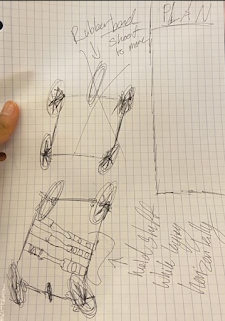
  Abstract: In our class Stem Skills, we explored the 8-step engineering design process of making out own functioning "car" using KNEX.  For this lesson our class split into groups in order to make a fully functioning transportational device that can carry items over a distance. My group consisted of 4 members. Anandi Durgam, Sanvi Guruprasad, Aditi Aurnprakash, and me.  Step 1: Define the Problem In this part of the process, we had to first evaluate the problem and what goals we needed our prototype to achieve. For this we outlined our goals for our model as first being able to move, second being able to carry objects, and third able to carry objects while moving  Step 2: Research the Problem For this second step we had to research what others had done and what constraints, limitations, or criteria we had to abide by in order to make out model. One such constraint is that the only items we were given to build the prototype was only a single bag of KNEX blocks w...

June 3: Self Driving Cars

Image
  The ethical dilemma of self-driving cars - Patrick Lin - YouTube

Me and GSSE!

Image
 Introducing Me